

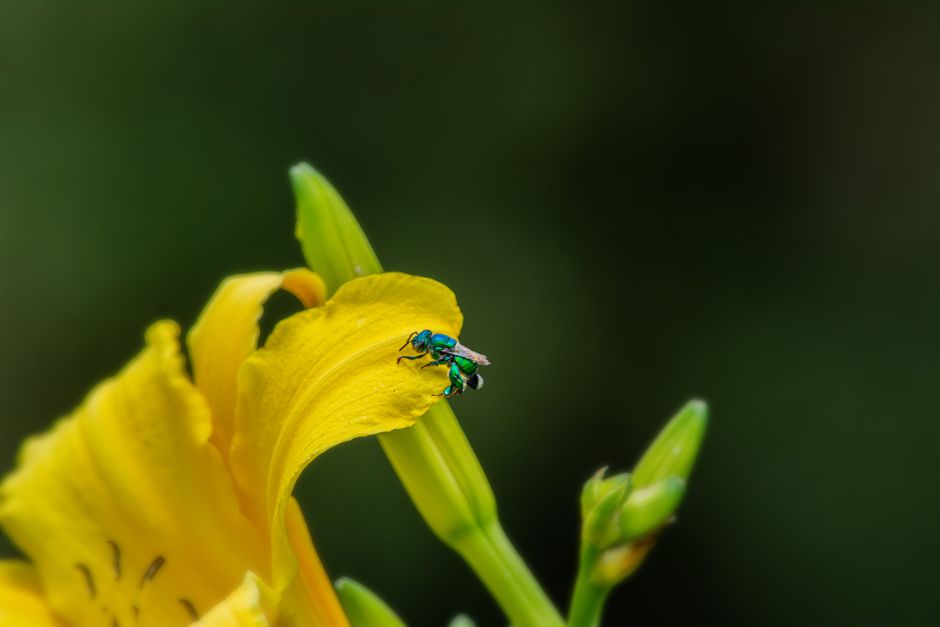
If you have ever noticed a brilliant metallic green bee visiting flowers in your garden, you may have wondered whether you were looking at a green honey bee. These striking insects can display shades of emerald green, blue-green, turquoise, or even copper, making them some of the most colorful bees found in North America.
Despite their appearance, the bees commonly described as green honey bees are not actually honey bees. True honey bees belong to the genus Apis, while many metallic green bees seen in the United States belong to the family Halictidae, commonly known as sweat bees. Other metallic green species occur in additional bee families as well.
For beekeepers, gardeners, and anyone interested in pollinators, these native bees are worth getting to know. They may not produce harvestable honey, but they play an important role in pollinating wildflowers, garden plants, fruits, and vegetables.
The short version: almost every bee called a "green honey bee" is a native sweat bee, not Apis mellifera. It lives differently, nests differently, and makes no harvestable honey — but it is a valuable pollinator.
What Is a Green Honey Bee?
The term "green honey bee" is generally an informal description rather than the scientific name of a particular species. People often use the phrase after encountering a small bee with a shiny green body and assuming that it is an unusually colored honey bee.
One of the best-known groups fitting this description is the genus Agapostemon. These insects are frequently called metallic green sweat bees.
Unlike the familiar European honey bee (Apis mellifera), which is generally golden-brown to dark brown with bands across the abdomen, metallic green bees can have a remarkably reflective appearance. Sunlight striking their exoskeleton can produce an almost jewel-like green coloration.
Some species have mostly green bodies, while others combine a metallic green head and thorax with a striped or darker abdomen.
Green Bees vs. Honey Bees
From a beekeeper's perspective, the biggest distinction is how these insects live.
European honey bees are highly social insects. A healthy colony can contain tens of thousands of workers living together with a queen and drones. They construct wax comb, raise brood communally, store large quantities of honey, and maintain the colony through winter.
Most metallic green bees have very different lifestyles.
Many are solitary or display varying degrees of social behavior depending on the species. Instead of occupying a wooden hive or a hollow tree filled with wax comb, many green sweat bees nest in the ground. A female may excavate a tunnel in suitable soil and create individual chambers where she places pollen and nectar provisions for developing offspring.
They also do not maintain the enormous honey reserves associated with Apis mellifera. Therefore, a beekeeper should not expect to find a hive filled with green bees producing frames of harvestable honey.
Why Are These Bees Green?
The extraordinary color of metallic green bees comes largely from the physical structure of their exoskeleton rather than simply functioning like ordinary green pigment.
Microscopic structures interact with light to produce the metallic appearance. Depending on the species, lighting, and viewing angle, the same bee may appear emerald green, blue-green, bronze, or copper.
This coloration makes green bees especially noticeable on contrasting flowers.
A metallic green bee working a yellow sunflower, for example, can be difficult to miss once you know what to look for.
Are Green Honey Bees Native to the United States?
Many of the metallic green bees encountered in North America are native bees.
That distinction is important for anyone interested in beekeeping and pollinator conservation. The western honey bee maintained by most American beekeepers, Apis mellifera, originated outside the Americas and was introduced centuries ago.
North America, however, supports thousands of species of native bees. They include bumble bees, mason bees, leafcutter bees, carpenter bees, mining bees, sweat bees, and many others.
Metallic green sweat bees are part of this tremendous native bee diversity.
Their presence around your property is generally a positive indication that flowering plants and nesting habitat are available.
Green Bees as Pollinators
Honey bees receive enormous attention because of their importance to agriculture and honey production, but they represent only one part of the pollinator community.
Metallic green bees regularly visit flowers to collect nectar and pollen. During this process, pollen can be transferred between flowers, contributing to plant reproduction.
You may find green bees visiting plants such as asters, coneflowers, sunflowers, goldenrod, black-eyed Susans, and numerous garden flowers and native wildflowers. The exact plants visited vary according to species, region, and season.
For a beekeeper, seeing multiple types of bees working the same flowering area can be fascinating. Your honey bees may be gathering nectar from one section of a flower patch while tiny native sweat bees work nearby.
A productive pollinator habitat does not have to support just one kind of bee.
Where Do Green Bees Nest?
If you want green bees around your property, understanding their nesting requirements can be just as important as planting flowers.
Many metallic green sweat bees are ground-nesting bees.
They typically prefer areas of exposed or lightly vegetated soil where females can excavate tunnels. Unfortunately, homeowners sometimes mistake these small entrances for ant nests or undesirable insect activity and immediately apply pesticides.
That can destroy valuable pollinator habitat.
Beekeepers interested in supporting native bees should consider leaving some areas of their property relatively undisturbed. Not every square foot needs to be covered with thick grass, mulch, gravel, or landscape fabric.
A sunny patch of well-drained exposed soil can provide nesting opportunities for ground-nesting native bees.
Do Green Bees Sting?
Like many bees, female sweat bees are physically capable of stinging. However, they are generally not insects that actively seek confrontation with people.
A solitary bee has a very different colony-defense strategy from a honey bee guarding thousands of workers, brood, stored pollen, and honey.
The simplest approach is to leave nesting and foraging bees alone and avoid handling them.
Beekeepers already understand an important rule that applies equally well to native bees: respect the insect's space and behavior.
How to Attract Green Bees to Your Property
Creating habitat for green bees does not require purchasing a hive. In fact, providing natural habitat is often the best strategy.
Start by increasing the diversity of flowering plants on your property. Ideally, something should be blooming throughout as much of the growing season as possible.
Native plants are particularly valuable because local bee species have long ecological relationships with native vegetation.
A good pollinator area might contain spring flowers followed by summer plants such as coneflowers and mountain mints, with asters and goldenrods providing important late-season resources.
Avoid unnecessary pesticide applications, particularly insecticides applied directly to blooming plants.
You should also provide nesting habitat. Leave small areas of exposed soil for ground-nesting bees and preserve natural stems, dead wood, and other habitat where appropriate for species with different nesting strategies.
Finally, allow portions of your landscape to be slightly less manicured.
What looks untidy to a homeowner can sometimes look like prime real estate to a native bee.
Can Green Bees Live Near Honey Bee Hives?
Yes. It is completely normal to have native bees living and foraging near managed honey bee colonies.
As a beekeeper, I would view a variety of pollinating insects around an apiary as something worth observing rather than eliminating.
Honey bees and native bees may visit many of the same flowers. The relationships among pollinators, floral resources, competition, and habitat are complex, which is another reason that maintaining abundant and diverse forage is valuable.
Planting more flowers benefits your managed colonies while also creating resources for wild pollinators.
Identifying a Green Bee
Color alone should not be used to make a definitive species identification.
If you encounter a metallic green bee, take a clear photograph without disturbing it. Try to capture the head, thorax, abdomen, legs, and overall body size.
Look at whether the entire body is green or only the head and thorax. Notice whether the abdomen is striped, dark, or metallic.
These characteristics can help narrow the identification.
Species-level identification can sometimes require examination of very small anatomical features, so a photograph may only allow identification to a genus or family.
Green Bees Deserve a Place in the Pollinator Garden
The so-called green honey bee is a perfect example of how diverse the bee world really is.
When most people hear the word "bee," they immediately picture a yellow-and-black honey bee living inside a hive. Spend enough time around flowers, however, and you quickly discover an extraordinary variety of bees with different colors, sizes, nesting behaviors, and life cycles.
Metallic green bees are among the most beautiful.
Although these insects do not provide beekeepers with jars of honey, they provide something equally important to the ecosystem: pollination and biological diversity.
For beekeepers, supporting these native pollinators can be as simple as planting a diverse selection of flowers, reducing unnecessary pesticide use, preserving nesting areas, and learning to recognize the insects sharing our landscape.
The next time you see a tiny emerald-colored bee sparkling in the sunlight, take a closer look. You probably haven't discovered a new variety of honey bee. Instead, you may be watching one of North America's remarkable native bees doing the pollination work it has been performing for generations.